Recently, I spoke on this topic to the Columbus chapter of ILEA (International Live Event Association). After hearing some positive feedback from the attendees, I was asked to post an article going over some of the information so they could share it with their other creative friends. While I’ve covered one of these tips on“Blowing Through Artist Block”, I have yet to post the remaining 4 tips I covered the other day. So here it goes…
Creativity isn’t just a personality trait. It’s a skill set that can be engineered and redesigned to help in all areas of your life. Much like math skills or literary skills, creativity can be a tool belt for unique ways of problem solving!
To borrow a few sentences from the Broad & High website: [The show is] “an exciting and original weekly magazine show, developed by the award-winning production team of WOSU Public Media, explores the character and creativity of Columbus and beyond.”
I believe this whole heartedly and I’m tremendously honored to have been part of this lovely series.
______________________
Thank You
A huge thank you goes out to producer Jackie Shafer, videographer Kenny Sato, and the entire team at WOSU-PBS Broad & High for putting on a thoughtful and enriching show. The entirety of this series seems to be aiming for an ever-increasing understanding of culture both locally and abroad. I’m truly grateful to be selected for such a feature.
What It’s Like Being Filmed For An Afternoon?
Sanding (before/after)
Since this video was posted, I’ve had several people ask me what it was like to be filmed while working. This is a question asked more from other artists than anyone else. As you can imagine, art-making can often be a fairly solitary occupation and so it comes as sort of a shock to the system for some that a person would be filming one’s every artistic move.
My honest answer:
Strangely, I was more nervous with anticipation during the month or so between filming and air date than I was during the actual art-shadowing. There’s a whole list of strategic planning and editing processes that the public never sees in preparations for a production like this. The episode I was featured in was slotted for a distant time that seemed ages away from the original filming date. Although I was entirely comfortable in front of the camera, I found myself itching like a kid before Christmas for the air date. I was restless to unwrap the goodies under the tree.
As a former teacher, I’ve grown accustomed to giving demos and speaking intensely about the theories of art making. It was an extra benefit that Kenny Sato (the man behind the camera) was calm and quite easy to talk to. Sato’s genuine interest in my work and pleasant demeanor made it possible for me to remain true to those previously learned teaching habits. He was comfortable which made me feel comfortable. A true professional.
Somewhere in the ethos there’s a saying that goes something like, “For every minute of air time, there’s an hour of recording”.
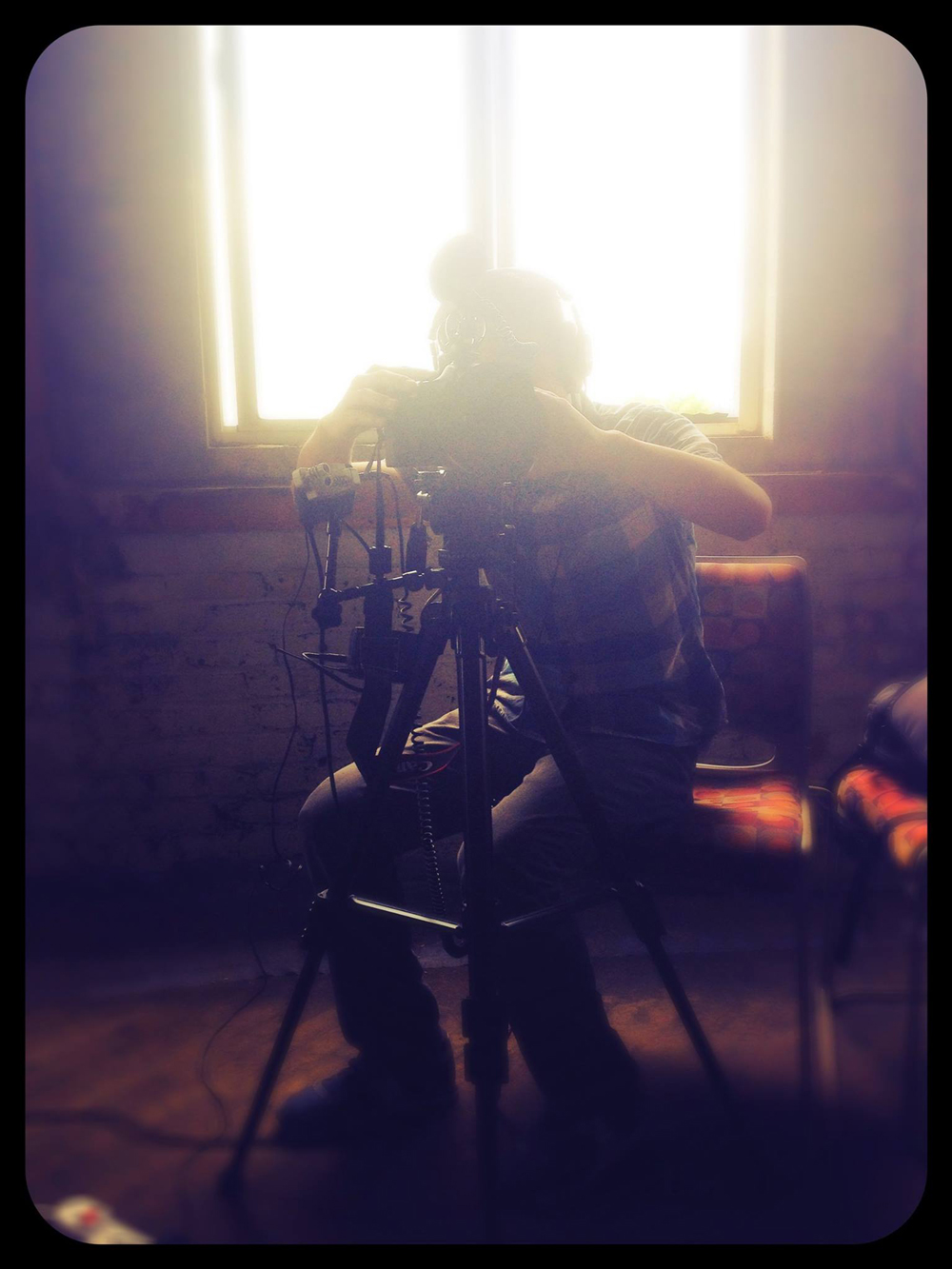
Filming my videographer, Kenny Sato
I’m not entirely sure how true this is in reality, but I can say that my interview lasted a fair amount of my afternoon. The camera followed me for several hours while I worked and I was surprised to find that after some time I actually became fairly oblivious to it. Again, I would say that Sato’s ‘fly on the wall’ approach aided in this comfortability. On minimal occasions he’d interject a question as I switched tasks or stopped recording to change memory cards. But for the most part, I brought my normal day’s worth of work and he let me do just that–work. It was sort of nice actually. Like having a quiet friend hang out with me while I was on the clock. Only I had just met him.
After filming my process for a while, we had an informal interview upstairs in an opened space. This was a little more like the TV interviews I’ve encountered before. Bright lights, cameras, sound booms, and cords-a-plenty pointed directly at me while I pretend they aren’t there. I always find this to be a pretty surreal experience. Immediately, I am reminded that I do that one thing with my hands too much. Next is usually a wave of forgetting how to breathe naturally. Then, a simultaneous amusement/bewilderment creeps in as I contemplate how one can think about breathing normally while giving an interview AND worrying about hand gestures… all while still not autonomously regulating one’s breathing. So, I gave up on multi-tasking brain faculties and settled into myself again. From there on out things sailed smoothly and I had a great time.
Again, it was a great experience. Thanks Jackie Shafer and Broad & High! Please navigate to their website or check out their broadcast on TV every Wed. night at 7:30p WOSU-PBS.
the quality of being thankful; readiness to show appreciation for and to return kindness
(Written in 2014) To all of you:
My dear family, friends, continued supporters, and anonymous readers whom I’ve not yet had the pleasure of meeting —
Over the past few weeks, I’ve felt compelled to write a letter of thanks to you. I looked internally for the catalyst that drives such an urge. Which monumental checkpoint must my subconscious be promoting so that I’d feel this overwhelming sense of thanks toward you? I started to calculate the separate adventures that you’ve helped me with over the years andI’ve come to this conclusion:
I was searching for that oneevent or reason to thank you. But the truth is, I have plenty of reasons. And they happen everyday. Your support comes in many forms. I thank you all for each.
My first solo show (c. 1999)
My first solo show as an artist was in 1999. Since then you’ve journeyed to my gallery openings, provided spaces to exhibit my work, made purchases, embraced my online media, strengthened my emotional infrastructure, congratulated me on my graduation from college twice, welcomed me into and out of the teaching world, and encouraged improvements when needed with constructive reinforcements. Whether you are my lifetime art companion or newly found electronic-media friend, I am grateful for the support you invest in my livelihood as a professional artist.
As my new website turns 1 year old this month, it’s celebrated with over 13,000 views and an ever-growing number of followers who are tuning in each week as I showcase my artwork, introduce my latest exhibition schedules, and learn about my life as an artist. These are 13,000+ endorsements that are in addition to your in-person support.
The phrase, “Thank you” is insufficient in comparison to how I honestly feel. My gratitude is plentiful and I am eager to return the kindness. Your vast forms of support give the vital nutrients and fertile ground from which continued success in the arts can grow. This, I’m truly thankful for.
Best,
Your Friend
Daric
You can find professional development articles for free on my Artist Resource page. My mission is to provide free and accessible tools for artists, educators, and enthusiasts. I encourage you to share and refer people here as often as you wish. Naturally, these articles take many hours to thoroughly research and write. If you’d like to support me as an artist and advocate, please consider donating whatever you can. Thank you!
If you’re an artist with a pulse you’ve probably struggled with applying a price to your artwork. It’s the most common concern for beginners & advanced artists alike. Sure, pricing can seem like a pretty intimidating thing. Especially if you’re starting from scratch.
“Wouldn’t it be just the greatest if there was a simple solution, something easy to remember, that could be used across the board to price our work?”
…. is the question you’re probably thinking in your head. Right?
The answer is No. That’s actually the worst way to price artwork if you hope to benefit yourself as a professional artist. There’s good news though: this article will explain why that system doesn’t work and hopefully shed light on an actual process that is unique to each artist while still being relatively easy to grasp. After speaking at great lengths with other professional artists, I’ve combined their knowledge with my own into what I hope is a comprehensive collection of information — for artists, by artists. Read on for more.





 Daric Gill
You must be logged in to post a comment.